
4 MIN READ
What is hot desking—and why does it work?
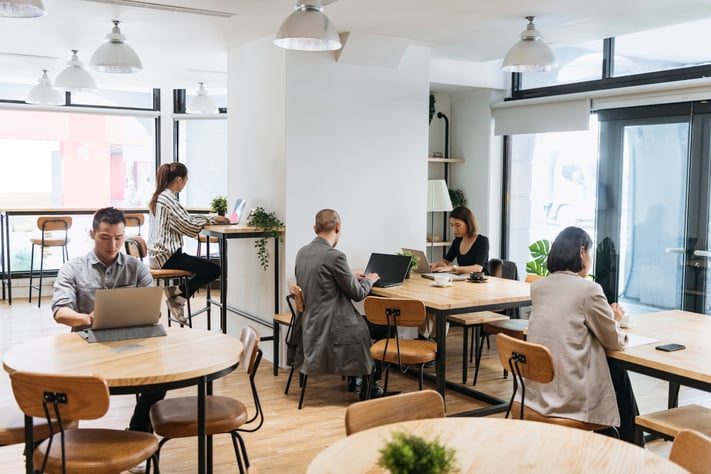
"Hot desking" has become a widespread solution for modern offices. When employees no longer have assigned seats but instead choose a workstation based on their needs for the day, it allows for better use of space, increased well-being, collaboration, and a more dynamic workday. This might mean sitting at a desk on Monday, in a meeting room the next day, and perhaps in a quiet zone for the rest of the week.
For many companies, this is a completely natural outcome of a more flexible workday, where the hybrid model has become the new normal. When you’re no longer physically present every day, it’s both cost-effective and practical to rethink office space.
However, hot desking isn’t just about freeing up square meters. It’s about creating a work environment that adapts to people, rather than forcing people to adapt to the space. If done right, this is a key component of the office solution of the future.
Why choose a hot desking solution?
It’s far from a coincidence that more and more companies are switching from fixed desk assignments to hot desking. This is about addressing real needs, such as the fact that the office may be only half-full several days a week, and that work capacity can vary. Not least, it is both expensive and unnecessary to pay for unused square meters.
Hot desking helps reduce excess space without compromising capacity, efficiency, or the overall office experience.
On the contrary, the report “Workplace of the Future 2025” from Entra and Epicenter indicates that this type of flexibility is viewed very positively by employees. In fact, people who work in flexible, activity-based offices report higher job satisfaction, a stronger sense of belonging, and a better work-life balance.
How to Improve Space Utilization and Collaboration Through Hot Desking
A flexible office also provides more movement and variety in daily life. Instead of desks sitting empty while employees are working from home, in meetings, or traveling, the space is adapted to actual usage. When the work environment is designed around activity and needs—rather than around fixed routines—the office becomes a tool for productivity, not just a physical place to show up.
At the same time, this has positive effects on collaboration and culture. When people aren’t always sitting with the same colleagues, the opportunity for informal conversations, spontaneous exchanges of ideas, and new collaborations increases. In knowledge-intensive environments, this can have direct value for innovation and interdisciplinary development.
According to the same report, 65% of employees state that social interaction is the main reason for coming to work in person.
Here, hot desking can be a direct contributing factor, as long as it is implemented correctly.
What Does It Take to Succeed with Hot Desking?
Although hot desking may seem fairly simple on paper, it requires a structured approach to succeed in practice. Without good tools and clear guidelines, you may end up with frustration and confusion instead of flexibility. Where are the open spaces? Where are your colleagues sitting? Is there a dedicated room for focus and concentration?
That’s why hot desking must be supported both physically and digitally. This means providing zones tailored to different work styles, having effective booking solutions, and—most importantly—making information easily accessible.
At the same time, you need insight into how the office is actually used—which areas are popular, when occupancy is highest, and where there is potential for improved workflow.
Read more about how a workplace analysis can help here!
How can technology optimize hot desking?
Tools, such as those we offer at BLDNG, play a crucial role in this. Our platform can provide real-time data on how the office is used, which zones have available capacity, and where employees are seated. This provides peace of mind for employees and valuable insights for management. At the same time, both operations and maintenance are simplified—because you know where demand is highest and which areas can be scaled back.
Hot Desking for the Workplace of the Future
The future of hot desking isn’t just about space, but about the workplace experience. We’re seeing a growing expectation that the office should support collaboration among people, as well as facilitate both focus and well-being. Therefore, technology will play an increasingly important role, with AI and predictive analytics providing even better workflow and personalization. At the same time, values such as health, a sense of belonging, and autonomy will become even more important to consider when designing an office.
According to the report from Entra and Epicenter, employees in flexible office environments report lower absenteeism due to illness and higher overall engagement. When people are able to work in a way that suits them, it has a ripple effect on well-being, performance, and loyalty.
Ready to explore hot desking in practice?
Hot desking is not just a trend, but a concrete response to how we work now and how we want to work in the future. But for it to work, it has to be done right. At BLDNG, we help you understand your office and employees in real time. Our solutions provide insight, structure, and flexibility, and facilitate better use of both space and human resources.
Want to learn more about how hot desking can work for your organization? Contact us here!