
5 MIN READ
How to Set Up a Hybrid Office That Works for Both Employees and Management
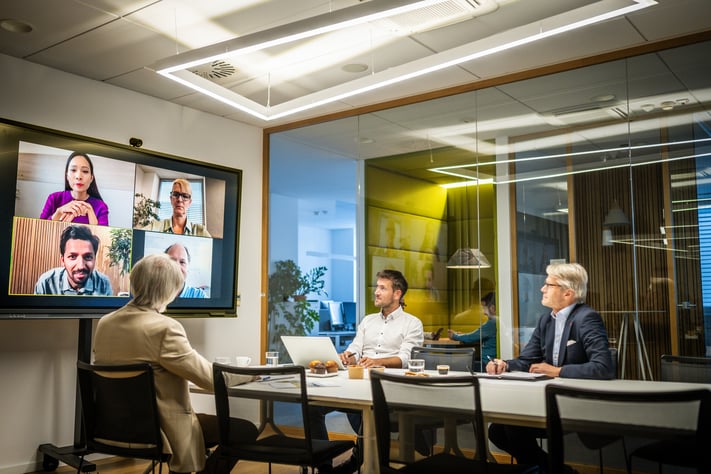
Establishing a well-functioning hybrid office requires more than just a combination of home office and office space. When we at BLDNG talk about hybrid offices—or, more precisely, what a hybrid office is—we’re talking about creating a workplace that supports flexibility, productivity, and management’s need for control and insight.
Definition and Why Hybrid Offices Are Becoming the Standard
First, what is a hybrid office? A hybrid office solution means that employees alternate between working from home and at the office, with flexibility in terms of time and location. For management, this means that the office space must be designed to facilitate both in-person meetings and on-site collaboration, while also integrating remote work.
Market trends show that hybrid offices are becoming the standard for an increasing number of companies. With increased digitalization and demands for flexibility, it’s becoming essential to design office spaces that aren’t static, but rather adaptive and data-driven.
Assess needs, both for employees and management
The first step in setting up a hybrid office is to assess needs:
- What do employees want? For example, access to quiet rooms, bookable meeting rooms, and flexible workspaces.
- What does management require? An overview of space utilization, cost-effectiveness, and insight into which areas are actually being used.
- How do these needs differ when employees are in the office versus at home?
BLDNG offers solutions that provide both a user experience and management insights. For employees, our solution—via an app or information screen—provides an overview of available workspaces and meeting rooms. For management, we provide “workplace analytics” that show how spaces are used over time.
Design flexible zones and technology that support hybrid work
Once you have a clear picture of the needs, it’s important to design the office with “zones” that support hybrid use:
- Hot-desking/benching: Workstations that are booked or used as needed.
- Quiet/focus zones: For tasks that require concentration.
- Collaboration zones/meeting rooms: For in-person interaction and teamwork.
- Remote integration: Technology that makes it easy for employees working from home to connect and participate.
With BLDNG’s sensors and platform, you can access real-time data and historical metrics that show how these zones are actually being used—so you can adjust the number of workstations, the number of meeting rooms, their placement, and more.
Implement a booking system, analytics, and flexibility
A hybrid workplace requires robust infrastructure for bookings, oversight, and analytics:
- Implement a booking system for workspaces and meeting rooms—so employees can easily view and reserve them via an app or screen. These are services we offer.
- Set up sensors and analytics engines that provide insights into usage: how many workstations are in use, how many meeting rooms are empty (“ghost meetings”), and which days have high traffic. BLDNG offers this.
- Use the analytics to make adjustments: fewer workstations on days with low attendance, more flexible use on days with high usage, and adjusting zones based on actual usage.
- Update policies: Define clear rules for office vs. remote work, which days employees are expected to be in the office, how hybrid meetings are organized, etc.
Ensure good communication and culture
A hybrid office works best when culture and community are prioritized:
- Management must communicate the vision: Why do we have a hybrid office? What benefits does it provide for both employees and the business?
- Employees must feel confident that the office space is designed with them in mind; if the office is perceived as unpleasant or inflexible, motivation will suffer.
- Use data (from BLDNG) to highlight how the office is actually being used, along with feedback from employees, so you can continuously improve the work environment.
- Make sure technology doesn’t become a barrier: booking systems must be user-friendly, workspaces must be equipped with the necessary IT and infrastructure, and meeting spaces must have reliable digital connectivity.
Continuous Evaluation and Optimization
A hybrid office isn’t a one-time project—it’s an ongoing process.
- Use reports and analytics to evaluate: Which workspaces are being used? Which ones aren’t? How often?
- Adjust the number of workstations, furniture, zones, and technology usage based on these insights. BLDNG’s platform makes this possible by exporting data and integrating with other systems.
- Involve employees in the evaluation: What’s working? What’s proving challenging?
- Update the office policy as needs change. For example, in response to changes in work patterns, organizational structure, or technology platforms.
How BLDNG Helps You
As your partner on this journey, BLDNG provides a technical platform and insights solution. Our solution enables you to understand and improve your workplace based on data. We offer:
- Sensor technology and a platform that measures the use of workspaces, zones, and meeting rooms.
- User- and employee-focused solution: Employees can easily reserve workspaces or meeting rooms via an app or screen and view real-time status.
- Management insights and analytics: reports and dashboards that provide management with an overview of space utilization, costs, and flexibility.
- Integrations with other systems: We offer an open platform with numerous integrations.
With BLDNG, you can set up a hybrid office in a way that balances employees’ need for flexibility with management’s need for control and insight.
Summary
Setting up a hybrid office that works for both employees and management is about understanding what a hybrid office entails, assessing needs, designing flexible zones, implementing technology and booking systems, communicating the culture, and continuously evaluating performance using data. As a provider of insights and platform solutions for office environments, BLDNG is ready to contribute both the technological foundation and strategic support. Feel free to contact us to discuss how we can work together to create a hybrid office that not only functions effectively but also becomes a competitive advantage for your business. We look forward to helping you!